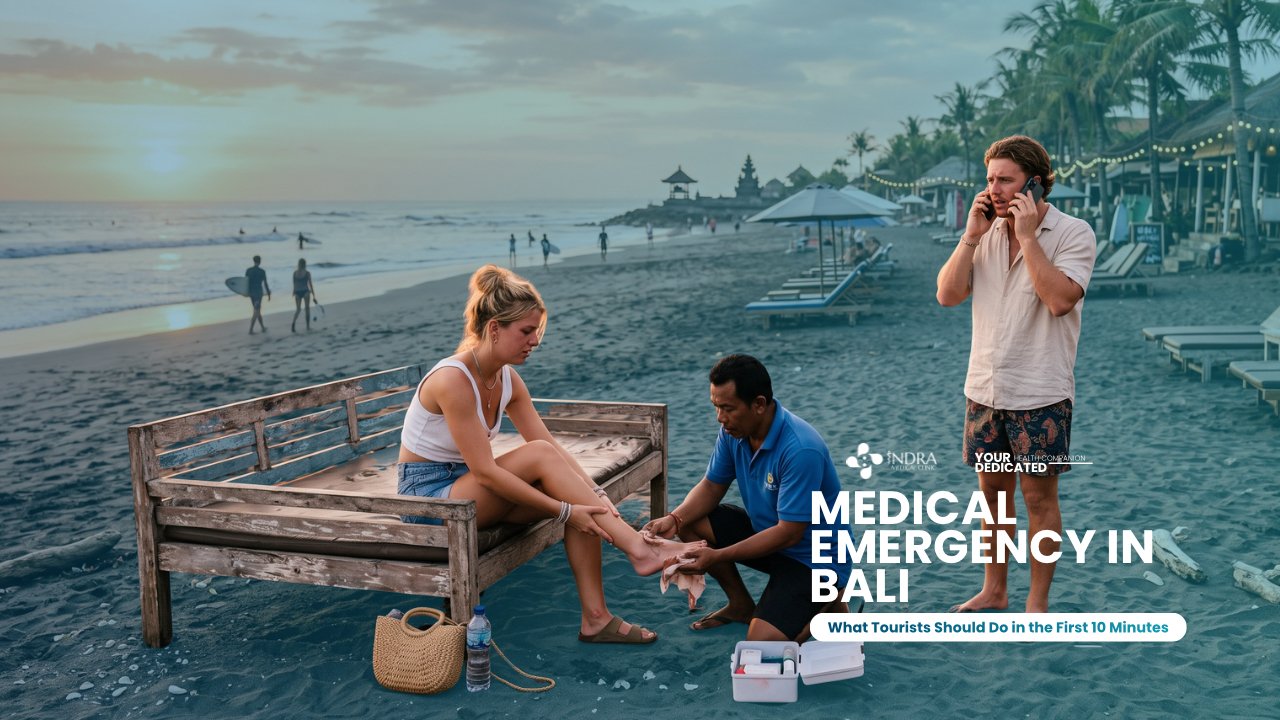
A medical emergency can happen anywhere in Bali — at the beach, in a hotel, during a motorbike trip, or while enjoying Bali nightlife. In the first few minutes, staying calm and taking the right steps can make an important difference.
For tourists, the situation can feel even more stressful because you may not know the local emergency system, where the nearest hospital is, or how to communicate the patient’s location.
Here is what to do during the first 10 minutes of a medical emergency in Bali.
Minute 0–1: Make Sure the Scene Is Safe
Before helping, quickly check whether the area is safe.
Move away from traffic, electrical hazards, fire, unstable structures, or other immediate dangers if it can be done safely. If the emergency occurred at the beach or in the water, do not put yourself at risk while attempting a rescue.
If a trained lifeguard, Balawisata officer, security officer, or other trained responder is nearby, ask them to assist.
Minute 1–2: Check the Patient
Look at the patient’s responsiveness and breathing.
Ask loudly:
“Are you okay?”
If the person does not respond normally, check whether they are breathing normally. A person who is unconscious, not breathing normally, has severe difficulty breathing, has major bleeding, experiences a seizure, or develops sudden severe chest pain or stroke-like symptoms may require emergency medical assistance.
Do not give food, drink, or medication to an unconscious or severely confused person.
Minute 2–3: Call 118 or (+62) 823 13254095
For a medical emergency in Indonesia, call 118 or Indra Medical Clinic for emergency medical assistance.
When calling, clearly provide:
- Your exact location
- Hotel, villa, beach, restaurant, or landmark
- What happened
- Patient’s condition
- Whether the patient is conscious and breathing
- Your phone number
If possible, have another person make the call while someone stays with the patient.
Minute 3–5: Start Basic First Aid
If the patient is not breathing normally, emergency dispatchers may provide instructions while help is being arranged.
For severe bleeding, apply firm direct pressure with clean cloth or gauze.
If the patient is unconscious but breathing normally, maintaining an appropriate airway and monitoring breathing is important while waiting for professional help.
Do not attempt complicated procedures unless you are trained to perform them.
WHO’s Basic Emergency Care guidance emphasizes systematic initial assessment and early intervention for time-sensitive emergencies.
Minute 5–10: Prepare for Medical Help
While waiting for emergency responders:
Stay with the patient. Monitor their breathing and level of consciousness.
Prepare important information. If available, have their passport/ID, medication list, allergies, medical history, and travel insurance information ready.
Share the exact location. A hotel room number, villa name, beach entrance, restaurant name, or Google Maps location can help responders find you faster.
Do not move the patient unnecessarily. Particularly after a significant fall, road traffic accident, diving injury, or suspected spinal injury, unnecessary movement may increase risk.
If emergency services advise transport to a hospital, follow their instructions.
When Should Tourists Go Directly to Emergency Care?
Do not wait for a routine hotel or clinic consultation if the patient has signs of a potentially life-threatening emergency such as:
- Loss of consciousness
- Severe difficulty breathing
- Cardiac arrest or abnormal breathing
- Severe chest pain
- Stroke symptoms
- Severe bleeding
- Major trauma or serious road accident
- Severe allergic reaction
- Seizure that does not stop or repeated seizures
- Severe poisoning or suspected overdose
- Drowning or near-drowning with concerning symptoms
These situations require urgent medical assessment and potentially hospital-level emergency care.
What If the Situation Is Urgent but Not Life-Threatening?
Not every urgent medical problem requires an ambulance.
For example, a tourist may develop severe vomiting and dehydration, a painful wound, fever, an infected bite, persistent abdominal pain, or another condition that needs medical assessment but does not appear immediately life-threatening.
In these situations, a 24-hour doctor or hotel/villa medical visit may be an appropriate option depending on the patient’s condition and location.
A doctor can assess the patient, provide appropriate initial treatment, determine whether further testing is required, and arrange referral to a hospital when necessary.
The Most Important Rule: Don't Panic, Act
The first 10 minutes are not about diagnosing the patient yourself. They are about protecting the scene, recognizing danger, calling for appropriate help, providing basic first aid, and getting the patient to definitive medical care when needed.
If you are traveling in Bali, save 118 or Indra Medical Clinic contact in your phone before you need it.
Final Takeaway
In a Bali medical emergency, stay calm, call 118 or Indra Medical Clinic when appropriate, give your exact location, and do not delay emergency hospital care for a life-threatening condition. For urgent but stable problems, a qualified doctor may be able to assess you at your hotel or villa and help determine the next step.
In a medical emergency, every minute matters.